 Unichain
 contracts: from testnet to mainnet
Unichain is an EVM-equivalent Ethereum L2 built on the OP Stack. Its Sepolia testnet supports contract and integration testing before deployment to mainnet, where real value is at stake.
Updated on- Compatible development tools
- Hardhat and Foundry, configured with an RPC endpoint for the intended network.
- Public RPC limits
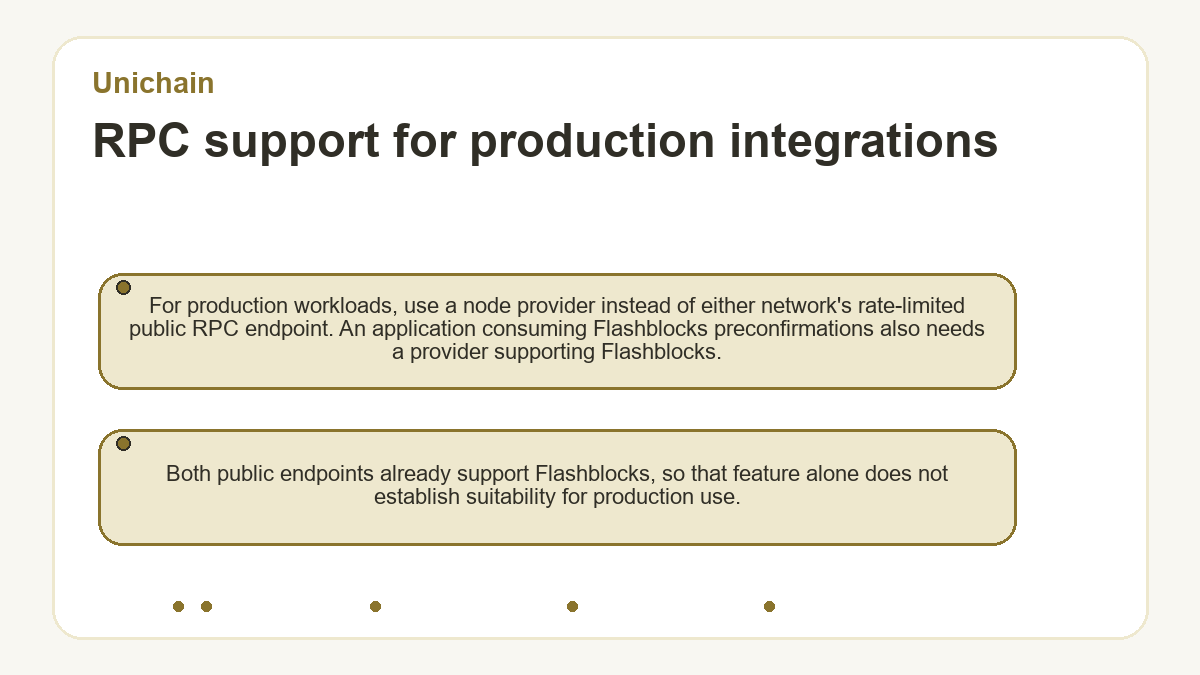
- Mainnet and Sepolia public endpoints are rate limited and are not intended for production workloads.
Testing against shared architecture
Sepolia uses test funds for testing contracts and application integrations before they reach the production network. Both environments share the OP Stack architecture and Flashblocks support, so testnet behavior closely matches mainnet behavior.
In a Foundry deployment, the deploying account needs ETH on the selected network to pay the transaction's gas fee. Test ETH funds deployment on Unichain Sepolia; a mainnet deployment needs ETH on Unichain Mainnet.
Network parameters for deployment
| Parameter | Unichain Sepolia | Unichain Mainnet | Deployment and integration constraints |
|---|---|---|---|
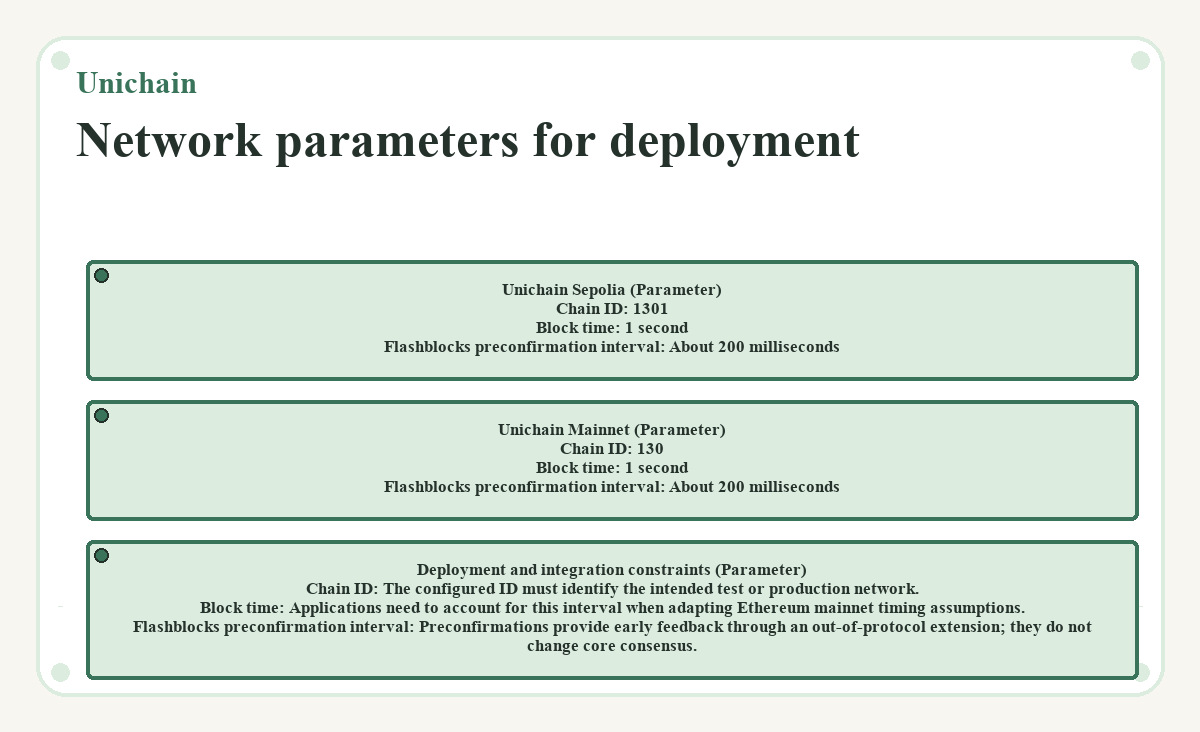
| Chain ID |
1301
|
130
|
The configured ID must identify the intended test or production network. |
| Block time | 1 second | 1 second | Applications need to account for this interval when adapting Ethereum mainnet timing assumptions. |
| Flashblocks preconfirmation interval | About 200 milliseconds | About 200 milliseconds | Preconfirmations provide early feedback through an out-of-protocol extension; they do not change core consensus. |
Ethereum tooling and network settings
Existing Ethereum development tools work on Unichain with the appropriate network settings. Point Hardhat or Foundry at an RPC endpoint for the intended environment and use its corresponding chain ID.
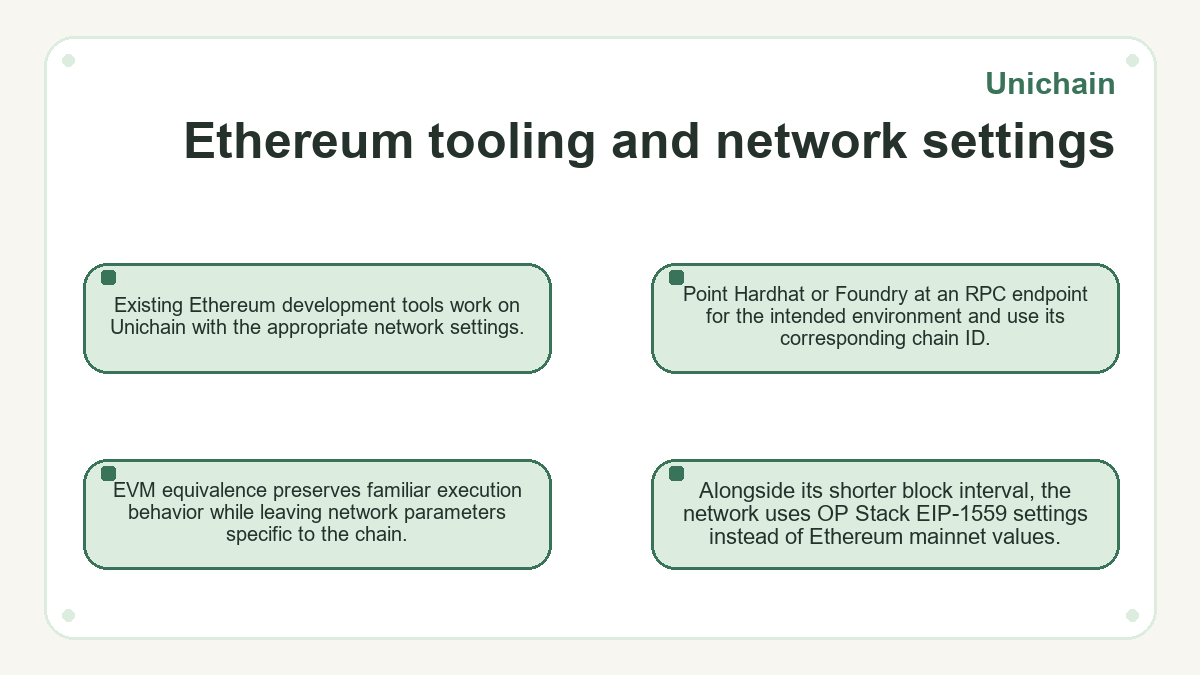
EVM equivalence preserves familiar execution behavior while leaving network parameters specific to the chain. Alongside its shorter block interval, the network uses OP Stack EIP-1559 settings instead of Ethereum mainnet values.
RPC support for production integrations
For production workloads, use a node provider instead of either network's rate-limited public RPC endpoint. An application consuming Flashblocks preconfirmations also needs a provider supporting Flashblocks.
Both public endpoints already support Flashblocks, so that feature alone does not establish suitability for production use.